

Strategic Dialogue for Co-Shaping PRIMA’s Future through Stakeholder Engagement
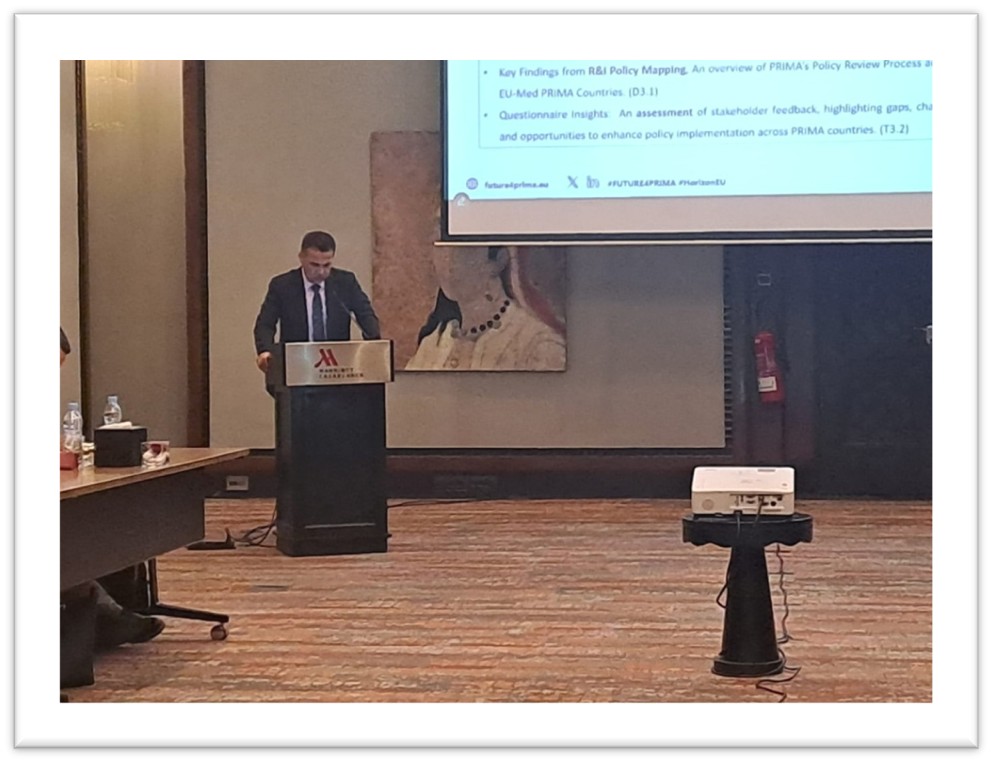
The FUTURE4PRIMA project, coordinated by PRIMA Foundation, hosted a major Strategic Dialogue for Co-Shaping PRIMA’s Future in Casablanca. The workshop brought together Mediterranean stakeholders — from academia, research organisations, national authorities, the private sector, and civil society — to discuss how research and innovation (R&I) policies can be better aligned and strengthened across the region.
The aim of the dialogue was clear: to expand and refine PRIMA’s policy review and selection process through inclusive stakeholder engagement, providing concrete inputs for the future evolution of the partnership and the design of PRIMA 2.


Opening Session
The event commenced with welcome remarks from the FUTURE4PRIMA Coordinator, followed by acknowledgements from the host, Mr. Anas Chokairi, representative of the Ministère de l’Enseignement Supérieur et de la Recherche (Morocco), co-leader of Work Package 3 and host of the workshop. An overview of the workshop’s objectives was then provided by Dr. Ra’ed Awdeh Assistant Secretary General, Higher Council for Science and Technology (HCST), Jordan, serving as co-leader of Work Package 3.
In their interventions, speakers underscored the urgency of addressing the systemic challenges facing the Mediterranean — including climate change, water scarcity, fragile food systems, and geopolitical instability — and highlighted the role of PRIMA as a strategic enabler of coordinated research and innovation cooperation across the region.
Session I: Overview of PRIMA’s Policy Review Process
Led by the Cyprus Institute (CyI, Cyprus) and presented by Mr. Fabio Montagnino representing CyI, the first session outlined the key findings of the R&I policy mapping exercise conducted across 19 PRIMA countries. The analysis highlighted areas of strong alignment — notably with the EU Green Deal, digital transitions, and Smart Specialisation Strategies — while also pointing to significant fragmentation in procedures, funding rules, and implementation mechanisms.
Moroccan representatives — spanning academia, public authorities, innovation hubs, and civil society — contributed valuable national perspectives, ensuring that local insights enriched the regional debate, which was moderated by Mr. Anas Chokairi, representative of MESRSI (Ministère de l’Enseignement Supérieur, de la Recherche Scientifique et de l’Innovation).

Session II: Assessing R&I Policy Practices Across PRIMA Countries
The second session, organised by the Ministère de l’Enseignement Supérieur, de la Recherche …
– MESRSI_ (Morocco), focused on the results of the T3.2 questionnaire and a structured open discussion.
A Balanced Mediterranean Perspective
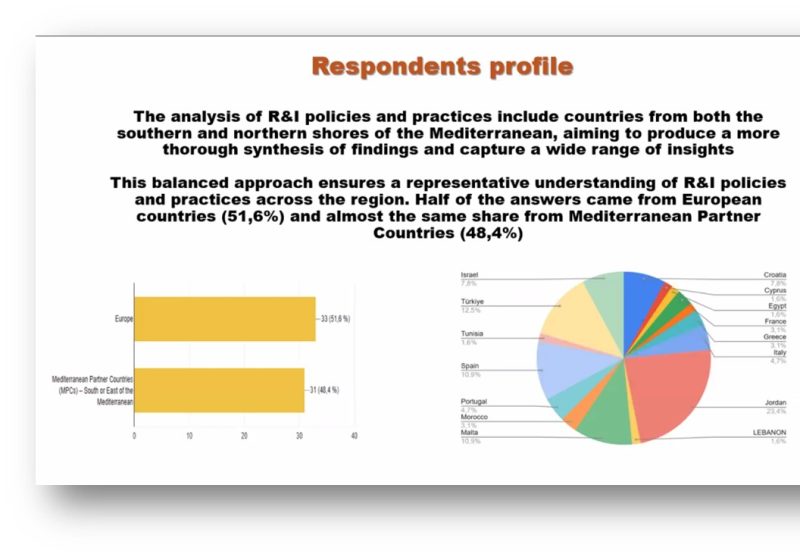
The survey collected input from both shores of the Mediterranean, with contributions almost evenly split between European countries (52%) and Mediterranean Partner Countries (48%). Strong participation came from Jordan (23%), Turkey (13%), as well as Spain, Morocco, Tunisia, and Portugal — ensuring diverse insights into regional R&I practices.
Key Insights
• Strengths: National funding mechanisms and coordination models provide solid foundations for cooperation.
• Collaboration culture: Nearly 70% of institutions already partner nationally and internationally, showing strong potential for scaling joint action.
• Persistent barriers: Fragmented procedures, limited national funding (67%), and long delays in evaluation and contracting undermine efficiency.
• Participation gaps: Funding remains concentrated in academia (83% universities, 72% research institutes), with weaker engagement of private sector and NGOs.
Strategic Takeaways – The Way Forward
Wrapping up the session, Dr. Ra’ed Awdeh (HCST, Jordan) stressed that addressing fragmentation and inequality is critical for PRIMA’s future. He proposed a set of strategic priorities to strengthen the partnership:
• Shared vision & trust: Build a common Mediterranean R&I agenda around water, food, energy, climate, and biodiversity.
• Governance & commitment: Simplify transnational frameworks, reduce administrative burdens, and secure high-level political backing.
• Innovation pathways: Create regional hubs, boost technology transfer, and involve SMEs and the diaspora in bringing research to market.
• Capacities & talent: Promote multi-fund synergies, align research infrastructures, and expand training and mobility schemes.
• Societal impact: Mainstream SDGs, ethics, and gender equality, and adopt harmonised monitoring frameworks to track real-world impact.
Challenges in Section 2
One of the strongest messages emerging from the survey is that funding imbalances and reliance on national resources remain structural obstacles. Section 2 of PRIMA, which depends entirely on Participating States’ contributions, is especially vulnerable to unequal national capacities, procedural complexity, and delays. This leads to geographic imbalances, discourages smaller actors such as SMEs and NGOs, and threatens PRIMA’s principle of joint ownership and equal partnership. Political and economic instability further undermines reliability, while capacity-building needs in funding management and cross-border cooperation remain significant.

Conclusions
The Casablanca Dialogue confirmed that while PRIMA countries have solid policy frameworks and funding structures, success depends on overcoming fragmentation, ensuring inclusivity, and connecting science with innovation and society. These insights will directly inform the PRIMA Joint Programme and the design of PRIMA 2, with findings to be consolidated at the next workshop in Portugal (September 2025).